English
Autor:
Bechta Mariusz
Rok wydania:
2026
Liczba stron:
304 s. + 64 s. wkł. zdj.
ISBN:
978-83-8376-788-8
Tagi:
Do pobrania:
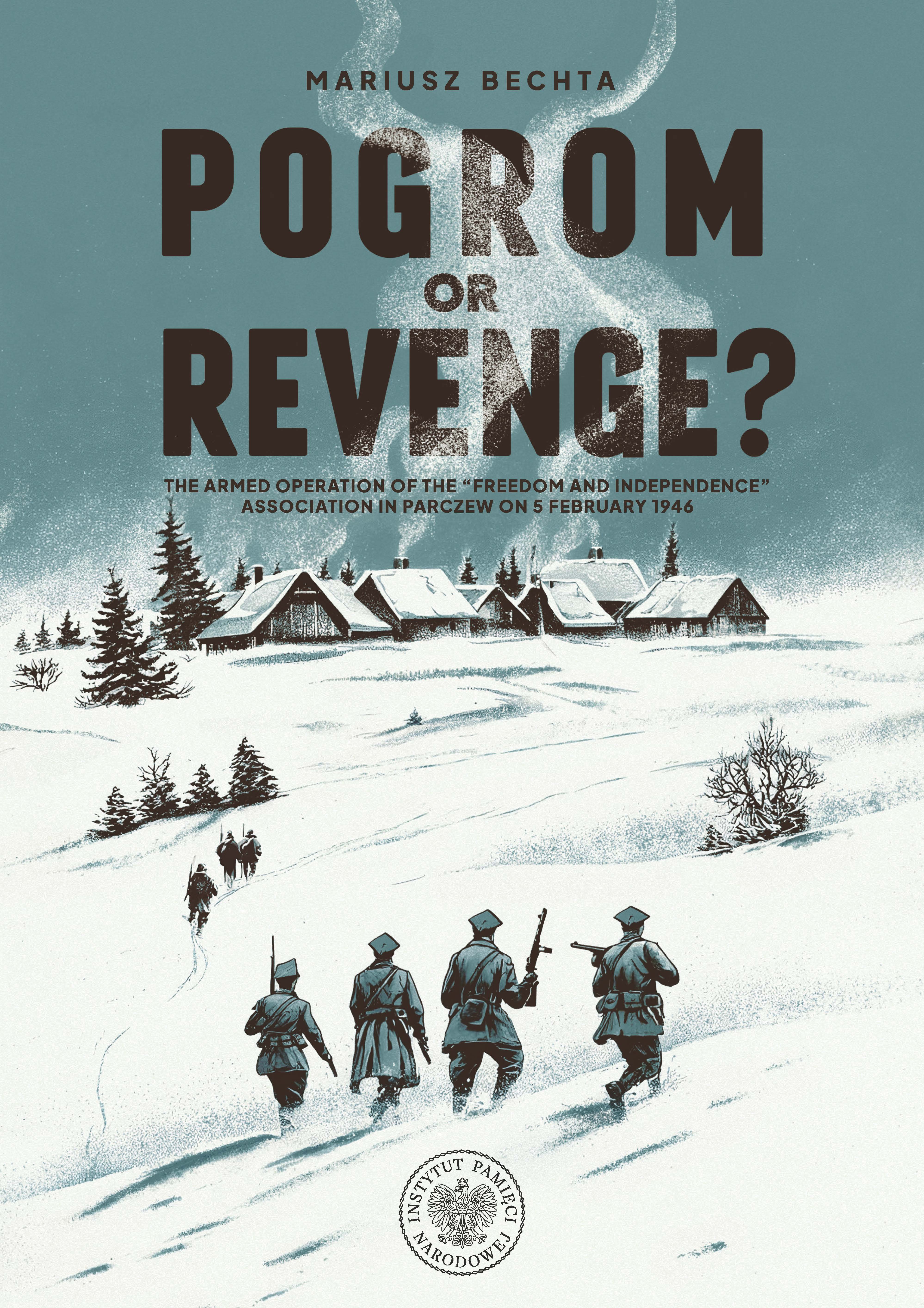
Mariusz Bechta, Pogrom or Revenge? The Armed Operation of the “Freedom and Independence” Association in Parczew on 5 February 1946, Warszawa 2026, 304 s. + 64 s. wkł. zdj., ISBN 978-83-8376-788-8
Foreword by Dr. Marek Jan Chodakiewicz, Professor of History at the Kosciuszko Chair of Polish Studies, Director of the Center for Intermarium Studies at the Institute of World Politics 
The book presents a micro-historical study of the attack on the town of Parczew in eastern Poland, carried out on 5 February 1946 by soldiers from the Polish anti-Communist Freedom and Independence Association (Zrzeszenie Wolność i Niezawisłość, WiN). By providing a meticulous analysis of the political, social, and cultural context as well as a detailed account of the incident itself, the author challenges the perception of the Parczew events as an anti-Semitic pogrom, thus far broadly accepted in historical literature. Rather, he argues that the WiN operation was strictly retaliatory in nature, directed not against the local Jewish community per se, but against those who collaborated with the Communist regime imposed on Poland by the Soviet Union.
The author broadly analyzes the historical context of the events. Going back as far as the inter-war period, he chronicles the relatively modest involvement of the Jews from Parczew and the surrounding Włodawa county in the Communist movement, and then in the Communist and Soviet partisan forces during World War II. He points out that, for the majority of Jews, survival was the priority during and after the conflict. In the latter time, this meant cooperation with whatever government constituted itself as the enforcer of law and order. Parallelly, the author tells the story of Communist brutality and terror against the Polish Christian population and Polish freedom fighters. This, combined with the humiliation of being subjugated and hunted like bandits after five years of bloody fighting, led to a fundamental conflict of interests between the Polish Christian majority and Jewish minority that ultimately resulted in the violence that ensued. However, the author points out that there was no attempt at the extermination or expulsion of the Jewish community of Parczew, while deadly force was used exclusively against Communist militants in the form of the Citizens’ Militia and the Jewish Town Protection Force, resulting in a total of four casualties. Nevertheless, the shock of the attack and the use of expropriation as a punitive measure against the few Holocaust survivors still living in the town led almost the entire community to emigrate, never to return.
Fundamentally, the book constitutes a voice in the ongoing discussion of the controversial subject of anti-Semitic violence in postwar Poland. However, the author conducted his study both broadly and deeply, discussing subjects such as the Communist movement in the Parczew area, the Communist, Soviet and pro-independence partisan forces, their fight against the German invaders and between each other, the fates of local Jewish survival and partisan groups, the establishment of the Communist regime, and local ethnic and political conflicts, also involving the Ukrainian/Ruthenian population. Historians, sociologists, and other scholars interested in these topics will find in this book a focused look at a slice of the broader history of World War II and the immediate post-war period in eastern Poland, a region of immense ethnic, religious, and political complexity.